Assessing the cost of injuries in professional football


An injured professional player affects the individual athlete and entails significant costs for the Club


To make sound managerial decisions, Clubs must be able to quantify both direct and indirect costs associated with player injuries.

Direct costs are relatively straightforward to define. They include medical expenses (diagnostic procedures, surgery, physiotherapy, rehabilitation), salary paid during absence, potential insurances or compensations, and possibly premiums for medical coverage or third-party services. Over time, Clubs may also incur additional direct costs if injuries lead to long-term consequences (chronic care, ongoing physiotherapy, or recurrence prevention programs).

Indirect costs, though harder to measure, often exceed direct ones. These include performance loss (fewer wins, poorer results), loss of form, reduced market value of the player, opportunity cost of not being able to field the player (e.g. need to sign a replacement or rely on less expensive alternatives), impact on team cohesion and competitive strategy, diminished revenue (less prize money, reduced ticket or merchandise sales), and even reputational damage if poor squad management becomes evident.

To translate injury into an actionable cost, a sports manager must combine epidemiological data and context-specific club parameters. For example, using data from a surveillance study(one such as the long-term study conducted under UEFA), a manager can estimate the expected number of injuries per season in a typical squad, and from there approximate average downtime. Then, applying actual salary and medical-cost data, the club obtains a baseline for direct costs.

Indirect costs require modelling different scenarios: substitution cost (bench players or new signings), potential performance drop, lost prize-money or broadcasting revenue, and long-term effects on market value. For players with high visibility or commercial value, an injury can affect sponsorship deals, which should also be factored in.

Beyond the monetary dimension, there is a strategic cost. Frequent injuries erode squad stability, force overuse of other players (increasing their injury risk), hinder tactical consistency and long-term planning. Thus, the value of a robust prediction strategy is substantial.

By implementing comprehensive injury-cost analysis, clubs can manage resources more efficiently, justify investments in medical staff or monitoring technologies, and align sports performance objectives with financial sustainability.

Here is where VALITICA’s proposition becomes compelling. With our analytical capacity and scientific approach, we help Clubs prevent unexpected costs due to injuries. The Club can construct detailed cost models: combining injury incidence data, player valuations, salary structures, performance metrics and revenue projections, to deliver a holistic cost-of-injury analysis. This enables sports managers to understand the full impact of injuries (direct and hidden), and make data-driven decisions on prevention strategies, resource allocation, and squad planning.

Shall we talk?

How we add value to professional football Clubs


Things tou need to know about Sports Medicine in a professional football context


Eric Schmidt, former CEO at Google, once said that “from the dawn of civilization until 2003, 5 exabytes of information were created, but now that amount of information is created every 2 days”. Far from being an exaggeration, this calculation is a faithful portrait of the society in which we live: our world is saturated with data.

What can we do with this amount of information?

The answer lies in data organization and interpretation. Whoever knows how to cross-reference, weave and create relationships between the billions of data generated every day will basically be one step ahead of the rest. It sounds like predicting the future, but no, it is making better decisions on a daily basis based on information.

This is what we do at VALITICA: We use big data, Artificial Intelligence (AI) and Machine Learning (ML) to empower the medical teams of football clubs with knowledge that allows them to predict the risk of injury, thus increasing the performance and well-being of players.

The fact is that proper injury management makes all the difference in high-performance soccer: according to data extracted from the clinical practice guidelines of the medical services team at FC Barcelona, the risk of injury in professional soccer is so high that it is as if a company with 25 workers were to lose 9 workers every month.

The key, then, is to provide medical teams with refined information that will be useful to them when designing, together with the entire technical staff, training sessions and planning competitions. Data such as the following:

  • Not all sports injuries can be predicted, only those in which the internal forces of the body are involved, such as those produced in training sessions due to poor execution of an exercise.
  • The lower extremities are the most commonly injured, with the thigh being the most affected anatomical area.
  • Hamstring injuries are the most recurrent.
  • The most common group of injuries is muscle/tendon injuries.
  • Most recurrent injuries occur within 2 months of return to play.
  • There is no difference in injury incidence between the top five European football leagues.

This knowledge becomes even more valuable when it becomes clear that the use of technologies such as AI is not as common in the world of sports medicine: “Little is known in this field of artificial intelligence in medicine and so far they are not used in a usual way in hospital settings, but we are clear that it will be the medicine of the future and we have to know about these tools to develop our skills in a comprehensive way in precision medicine,” says Dr. Irene Aguirre, Medical Lead at VALITICA.

How do we work at VALITICA?

We obtain huge volumes of data from EPTS devices that record biometric information, both in training sessions and in competitions. Among the variables we analyze are:

  • More than 11 workloads such as RPE effort perception scale, sprint speed, decelerations/accelerations, eccentric work with hamstring predominance.
  • Individual player information such as rest times/training times, previous injuries, etc.
  • Evaluation of training loads using the ACWR model.
  • Injury prediction using classifiers with RFECV.
  • Prediction of false injuries (known in statistics as “false positives”).
  • Classification of Foster’s variables.

Our goal in VALITICA is to put at the service of sports medicine proven, effective and innovative technologies that serve to increase the welfare of athletes. If you are part of the medical staff and you are interested in taking the next step, contact us today.

“Injury Prediction with AI: The Future of Sports Medicine”


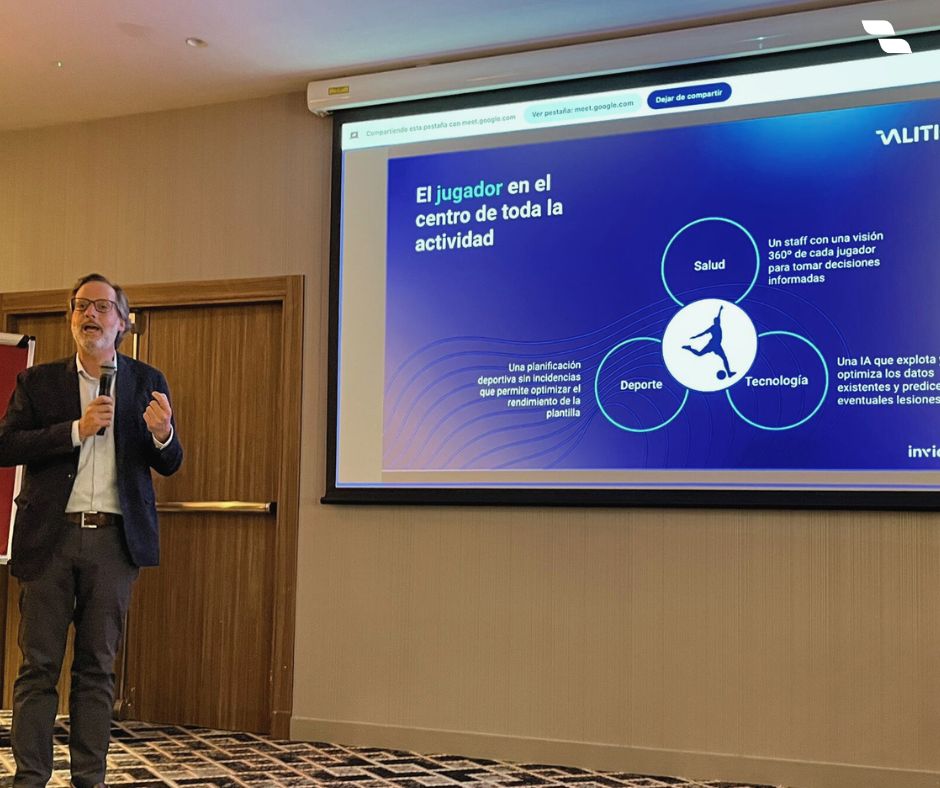
VALITICA and INVICTUM showcase new advances in AI-driven injury prediction for football


Last 28 May we held an event in collaboration with INVICTUM Sports Medicine Centre. The session brought together specialists in sports medicine, technology and artificial intelligence to present the latest progress in injury prediction for professional football players.

Prevention and prediction at the core

Speakers emphasised that prevention remains the foundation of modern sports medicine. Within this context, the VALITICA platform now gives clubs the ability to anticipate injuries before they appear by applying a dedicated artificial intelligence model trained with high-quality performance and medical data.

Artificial intelligence in sports medicine

Dr José Silberberg, director of INVICTUM, explained how artificial intelligence strengthens diagnosis, treatment and rehabilitation for complex injuries, including anterior cruciate ligament damage. He highlighted that the combination of clinical expertise and intelligent data processing leads to faster decisions and more accurate therapeutic pathways.

A complete 360-degree view of the player

VALITICA connects information from multiple sources such as coaching staff, medical teams, EPTS devices, laboratory tests and training reports. The result is a comprehensive overview of the player’s physical condition and current injury risk, which improves communication between departments and supports coordinated decision making.

Intelligent alerts for medical teams

The system can generate clinical notifications based on hundreds of variables. These alerts help medical teams respond quickly when a player shows early signs of overload, imbalance or elevated risk.

A robust predictive model

The VALITICA engine applies three layers of analysis. The first is an individual historical profile. The second identifies behavioural and load patterns across the team. The third is a general neural network that integrates global learning. Together, these layers calculate the probability of injury with precision and adaptability.

A service tailored to each club

The platform fits the operational needs of every organisation. It is delivered as an annual service that supports the full competitive season, offering clubs continuous monitoring and expert guidance.

This event reaffirmed VALITICA’s position as a leading force in applying artificial intelligence to sports medicine. Our approach brings together science, technology and football to help clubs protect their players, improve performance and reduce the global cost of injuries.

Watch the video here → (in Spanish)

Should you need to know more, do not hesitate to contact our team.

What is the “UEFA Syndrome”?


Understanding injury risk among professional footballers


In professional football, injury risk is substantial and persistent. According to the long-term data collected by UEFA via its elite-club surveillance projects, squads typically experience 50 injuries per season, meaning that in a roster of around 25 first-team players, each athlete sustains an average of two injuries per season.

The most frequent injury type identified is muscle-related, especially strains in the thigh region, notably hamstring injuries.

Over the years, the prevalence of hamstring injuries has increased significantly, by recent estimates, accounting for nearly a quarter of all injuries in men’s professional football.

These patterns reflect what is often informally referred to as “UEFA syndrome”: the chronic exposure of elite footballers to high workloads, intensive training sessions, frequent matches, and tightly packed calendars, resulting in repeated stress on the musculoskeletal system.

The concept captures not a single pathology, but a systemic issue: a combination of high internal and external load, inadequate recovery, and cumulative microtrauma.

Risk is not evenly distributed across contexts. Injury incidence during matches is markedly higher than during training 27.5 vs 4.1 per 1,000 hours of exposure), indicating that competitive demands significantly elevate risk. Over a match, the risk grows as time elapses: injury incidence tends to increase in both the first and second half. Furthermore, a non-negligible share of injuries are re-injuries (about 12 % of all injuries), and these tend to cause longer absences (on average 24 days vs 18 for first-time injuries).

The consequences of such a high injury burden are multifaceted. Beyond the immediate human cost (pain, loss of form or potential long-term career impact), there is a strategic impact on squad management, performance consistency, and financial burden for clubs. For players, repetitive muscle injuries can impair performance, hamper career progression, and increase risk of chronic issues. For clubs, recurrent absence of key players threatens competitiveness, complicates squad rotation, and imposes medical and rehabilitation costs.

Given such risks, injury prediction must be central in modern football. Prediction requires a holistic approach: managing workloads (both external and internal), ensuring appropriate rest periods, individualising training loads, and monitoring fatigue and recovery. Importantly, data-driven tracking becomes essential.

At this juncture, VALITICA can play a decisive role. By integrating robust injury surveillance systems, analysing player workload across training and matches, and leveraging advanced AI monitoring technologies, we help clubs quantify injury risk, detect early warning signs, and design tailored prevention plans, reducing the burden of “UEFA syndrome” on both players and Clubs.

Shall we talk?